RTP, or Return To Player rate, is the percentage of total bets a game pays back to punters over time. This percentage also reflects the house edge, making it a key factor for players, particularly when viewed over the long term. Although short-term results can be unpredictable due to luck, with both wins and losses expected, high RTP games reduce the house edge and increase the likelihood of long-term success.
Learn why the RTP rate is vital in online gaming and how you can leverage it to boost your winnings.
RTP, or Return To Player rate, is one of the key concepts players should understand before gambling online. In this article, you will learn what it means, how it is calculated, and how regular players can use it as an effective tool to maximize winnings.
What is the RTP (Return To Player) Rate?
RTP, or Return To Player rate indicates the percentage of all wagered money a game will return to players in the long run. The number indirectly reflects the house edge, hence its usefulness for players and it is more accurate over a long period.
Occasional wins and losses are inevitable, and in the short term, any outcome is possible, as luck is the key factor. However, a game with an RTP closer to 100% will return a higher percentage in the long run, so the house edge is diminished. This gives players a better chance to be successful in the long term.
How is RTP Calculated?
The calculation of the return to the player involves complex statistical analysis and factors in all the possible results for the game analyzed. The basic mathematical formula reflects the result of the total amount wagered when divided by the total amount won.
For example, if a slot has an RTP of 97%, it means that it will pay back $97 for every $100 wagered. The more spins of the reels, the more relevant the number, so the percentage is closer to reality when a million rounds are played, as opposed to 100.
Another example comes from roulette where the American version has an RTP of 94.74%, as opposed to 97.70% for European roulette. The extra 00 slots decrease the return to the player and boost the house edge. This a fine illustration why it’s so important to understand RTP and leverage it in gaming.
RTP vs. House Edge
Once you understand RTP, it is incredibly easy to calculate the house edge and the other way around. They are the different sides of the same coin because the house edge is the opposite of the return to the player. A slot with a 96% RTP has a 4% house edge, so their sum will always be 100 for any game.
Prospective players should be looking for these percentages whenever they consider a game. As long as the software developer or the casino featuring the game displays any of them, it’s easy to calculate the other. In the long run, a high RTP and a low house edge will improve your chances of winning.
Types of RTP
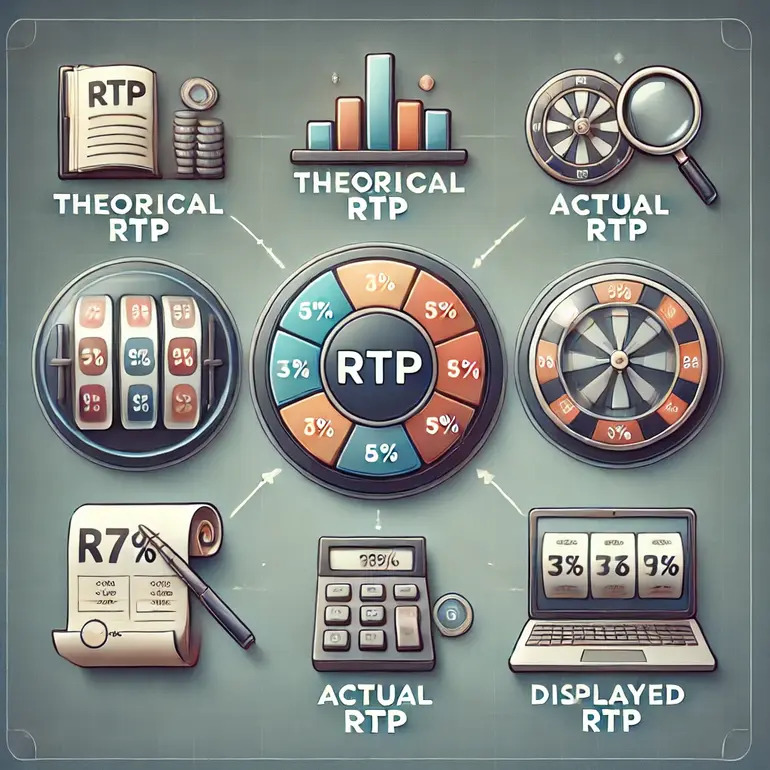
Theoretical RTP: This is the percentage a game is expected to pay back by way of prizes in the long run. It is calculated by the developer and published when the game is launched.
Actual RTP: Unlike theoretical RTP, this is calculated by simply dividing the total sums bet by the total sums won. This is done over a longer period to be conclusive, by testing and certification agencies. eCogra is a shining example of useful and accurate information on this topic.
Displayed RTP: Most casinos choose to display the RTP as a percentage of all wagered money a game will pay back to players over time. A few will display the house edge, so the RTP can be calculated by players by subtracting that figure from 100.
How to Use RTP to Choose Games
Gaming must, first and foremost, be fun, so the top priority should be playing a game you truly enjoy. When it comes to maximizing the odds of long-term winning, a game with a high RTP and medium-low volatility is the best choice.
Online slots fans should consider Blood Suckers, with an RTP of 98%, while those who love rock-themed games would be right to choose Gun n’ Roses of Jimi Hendrix with 96.9%. Video poker is also a fine option, with games such as Jack or Better sporting a return to player of 99.54%.
When it comes to slots, some players choose low RTP games because they love the theme, certain game mechanics or hunt for jackpots. Regarding roulette, the American version is sometimes preferred due to familiarity, and the fact that it is more accessible and available at lower stakes.
Common Myths about RTP
One of the most common mistakes people make about RTP is that it is relevant in the short run. For every big win recorded, there are many small losses incurred by unlucky players. In the very long run, luck evens out and the numbers come true, but it doesn’t apply to individual players or game sessions.
Another common misconception is that the RTP improves if you increase the stakes and that the maximum bet will deliver the best results. This is also a very dangerous mistake, as it can lead to the utter destruction of the entire bankroll over a short time.
RTP in Different Types of Casino Games
Slots players have the toughest mission in interpreting the RTP, due to the huge number of possible outcomes. There are jackpots, bonus buy features, multipliers, gamble features, and many more variables that greatly influence winnings. For slots, the RTP is only relevant in the very long run.
Table games fans have a much easier task, especially if they play roulette. Possible wins are directly influenced by the numbers covered with a bet, and the 0 or 00 slots determine the house edge. For blackjack, the biggest drives in RTP variations are the soft/hard 17 for dealers and double-down rules.
Video poker is a game that comes the closest to math and its RTP is strongly influenced by the choices made. Players who discard and keep cards based on the optimal strategy benefit the most from these games with an RTP revolving around 99%.
RTP and Long-Term Play
The Gambling Commission in the UK highlighted the importance of looking at RTP numbers through a long-term lens. Players can expect to offset more of their losses over the long term with high RTP games because luck and bad luck will even out over a sufficiently large number of games.
Variance is far more impactful in the short run because it has a greater impact on the outcome of individual sessions. A high-volatility game can produce bigger winnings, but it tends to do so far less often than medium-low-volatility games. Risk-averse players would benefit from playing the latter.
RTP and Player Strategy
Punters should always play the long game, and their main goal should be not to lose the bankroll. Proper management of the gaming budget is the key, and it implies betting just a fraction of it during each session. The lower the RTP and the higher the variance, the lower the sums wagered must be.
Betting strategies give players a sense of structure and a feeling of control, but they shouldn’t be overestimated. Progressive systems such as the Martingale are notoriously dangerous due to the high risks implied. Fixed percentage position sizing bets are safer as you increase the stakes when you win.

Conclusion
RTP (Return To Player) Rate is one of the most important concepts in gambling because it provides an accurate image of how much you can win in the long run. It is truly relevant when a huge number of games is factored in and shouldn’t be overestimated for individual sessions. The best results are achieved when it is used in conjunction with variance to maximize the odds of winning.
The bottom line is that players should always compare the RTP when considering similar games. It is by no means the only thing that matters, but it is one of the most important ones when trying to minimize the risks. We hope that the information presented here was useful and we encourage you to leave comments or questions below.


 Blackjack
 Slots
Slots Roulette
 Baccarat
 Craps
Craps Poker
Poker