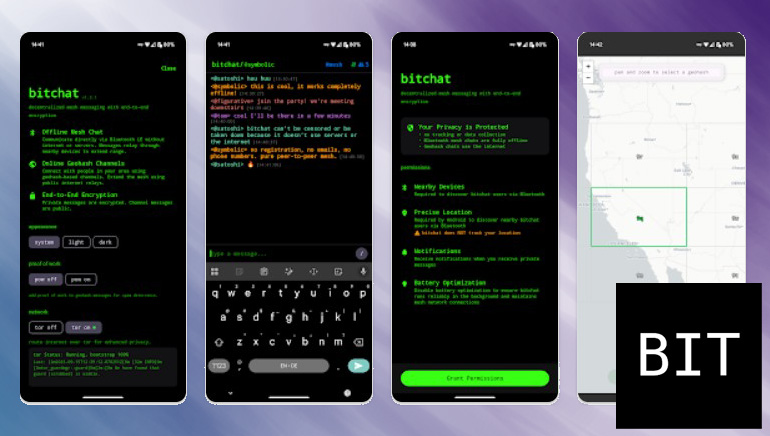
Jack Dorsey’s new Bitchat app uses Bluetooth mesh networks and advanced cryptography to send messages - and Bitcoin - without internet access. We unpack the tech, security questions, and what this decentralised shift could mean for crypto and iGaming.
When Jack Dorsey, Twitter and Block founder, builds something over a weekend, the industry pays attention. This time, it’s Bitchat, a decentralised messaging app that runs over Bluetooth mesh networks.
No servers. No phone numbers. No internet connection required. And yes, it supports Bitcoin transfers between nearby users.
At first glance, it sounds like a throwback to early peer-to-peer experiments. In reality, it’s something more ambitious: a stripped-down communications protocol designed to survive censorship, outages, and centralised control. It’s infrastructure-free networking with implications far beyond messaging.
Instead of relying on cell towers or Wi-Fi, Bitchat uses Bluetooth Low Energy (BLE) to form ad-hoc mesh networks. Every device acts as both client and server.
If your phone can “see” another device running Bitchat within roughly 100 meters, it forms temporary chains and connects to it. If not, it hops across nearby devices until it reaches the destination.
Traditional messaging apps depend on decentralised data centres. Even decentralised apps often rely on some form of cloud coordination. Bitchat removes that dependency.
If you’re in a physical proximity to other users, you're online - even if the internet itself is down. Apps like Bridgefy, however, proved Bluetooth mesh could function during protests and large-scale outages, so the concept is not new in theory.
What makes Bitchat different is timing and integration. It arrives in a world already primed for decentralisation. An era where Bitcoin, crypto wallets, and Bitcoin gambling have been adopted by the mainstream.
Unlike earlier experiments, Bitchat connects messaging with value transfer. Users can pass signed Bitcoin transactions device-to-device, and blockchain settlement occurs later.
Bitchat’s protocol design shows signs of modern development practices, including AI-assisted coding and architecture modelling. Dorsey may have built Bitchat quickly, but the layered structure, routing logic, and resilience mechanisms reflect how AI tools now accelerate complex system design.
AI-assisted development, through platforms like Emergent, is on the rise across software sectors, and Bitchat is a clear example of how quickly sophisticated peer-to-peer frameworks can now be assembled and reiterated.
We’re seeing a similar shift in the online casino space. AI models optimise game math, personalise bonuses, detect fraud patterns, and adjust live odds in real time. The parallel matters.
If AI speeds up decentralised tool creation, it lowers the barrier for infrastructure alternatives. That could ripple into industries that are heavily reliant on centralised tech stacks - including online gambling.
At its core, Bitchat solves three problems:
For remote or high-density regions where networks easily overload, Bitchat can be very practical. For crypto users, it’s strategic.
Bitcoin was designed as peer-to-peer electronic cash, but most transactions, in reality, still depend on internet access and centralised exchanges. Bitchat narrows that gap by allowing transaction data to move offline before final broadcast.
While the idea is revolutionary, the execution is still evolving. Security researchers quickly pointed out impersonation risks: safety, scalability, imitation apps, and timing disputes.
Without rigorous external audits, vulnerability may exist, and Dorsey has acknowledged that the app hasn’t yet undergone a full third-party review.
“In cryptography, details matter. A protocol that has the right vibes can have fundamental substance flaws that compromise everything it claims to protect,” says Alex Radocea.
There’s also a scalability issue: without enough nearby nodes, the “network” becomes a handful of isolated devices. Bluetooth mesh networks thrive in crowded environments, but sparse areas dramatically reduce reach.
Fake versions of the app have already appeared on certain platforms, adding confusion and phishing risks. In decentralised ecosystems, verification becomes the user’s responsibility. Though very empowering, it can be dangerous for the inexperienced or uninformed.
Timing is another concern, especially for financial use cases. If a Bitcoin transaction moves locally but isn't broadcast quickly, for instance, settlement delays could create disputes. In gambling, where outcomes are time-sensitive, this problem becomes very hard to ignore.
So, where can Bitchat intersect with online casinos and sportsbooks? Crypto gambling platforms already operate outside traditional banking restrictions by relying on blockchain, crypto wallets, smart contracts, and decentralised payment flows. Bitchat adds another layer: communication and transaction mobility without infrastructure.
Imagine a future where:
It may sound futuristic, but the logic already aligns with crypto gambling’s vision: fewer intermediaries, faster control, more transparency, more anonymity, more autonomy.
There's also a community component. Decentralised messaging reduces reliance on centralised social platforms, and crypto players value that kind of independence.

For years, we’ve accepted centralised infrastructure as essential and inevitable. Bitchat reminds users that the internet is not the only way devices can connect, which challenges the assumption.
In iGaming, similar shifts are happening. AI-assisted slot development is accelerating content pipelines. Blockchain verification is reducing trust friction. Crypto wallets remove traditional payment bottlenecks. The ecosystem is decentralising - layer by layer.
Bitchat fits into that broader pattern, and although it’s not a finished solution, it’s certainly a signal for what’s to come: infrastructure can shrink, devices themselves can coordinate, and value exchange doesn’t always need a middleman.
Bitchat may remain a niche experiment, or it could inspire a new wave of peer-to-peer infrastructure tools. Either way, it represents a clear move toward autonomy.
For industries built around digital value, especially crypto iGaming, that’s not a small development. It suggests a future where communication, transactions, and community operate with less dependency on centralised control.
If you’re curious about where decentralisation meets online betting, explore leading leading Bitcoin casinos and sportsbooks today.


 Blackjack
 Slots
Slots Roulette
 Baccarat
 Craps
Craps Poker
Poker