Crypto staking holds a fascination for online gamblers. Is it the chance to be the house, the passive income potential, or something else?
With the growing value of Bitcoin and other decentralised tokens, we have seen a surge in crypto casinos and a growing appetite from players to gamble using their favourite coins.
However, as the industry has begun to mature and cryptocurrencies are moving away from simply being the ‘hot new trend’ into a trusted financial instrument, how holders are using these digital assets is also evolving.
One of the use cases for this cutting-edge technology, which is gaining ground, is staking. Join us to learn more about this process and why it resonates with crypto gamblers.
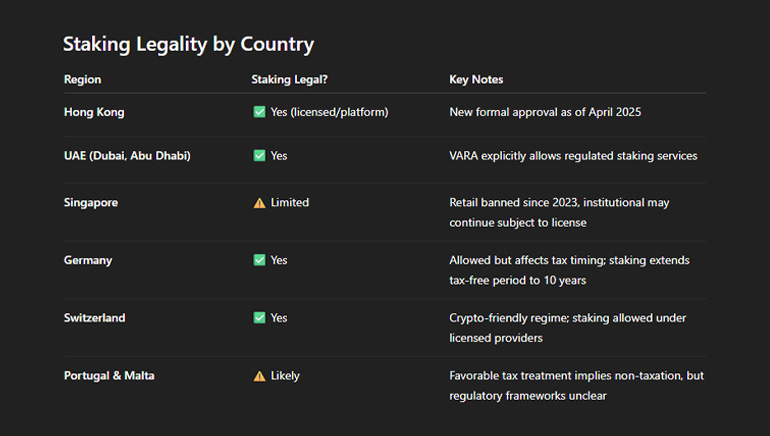
In recent news, the Hong Kong Securities and Futures Commission (SFC) amended its cryptocurrency legislation to allow Virtual Asset Trading Platforms (VATP) and exchange-traded funds (ETF) to offer crypto staking to their users.
This move saw the financial powerhouse join the ranks of Singapore (excluding retail staking), Germany, Switzerland, and the United Arab Emirates. All of these regions have ensured that their crypto laws, local crypto tax codes, and investment frameworks allow investors to stake their digital assets in yield-bearing products.
Malta and Portugal do not have specific laws governing the practice, but neither is there anything that claims it is illegal. This grey area, combined with their lack of capital gains tax for private investments, has made staking a hot topic amongst investors but kept platforms from going too hard until there is more regulatory clarity.
While both the European Union and the United States are on record as considering the legalisation of crypto staking, it is the United Kingdom that will most likely be the next big player to enter the space.
While crypto gamblers are used to funding their player accounts and using their assets to play slots or back a sports team, staking in this context is more like backing the house than wagering on the game.
Britannica Money defines cryptocurrency staking as:
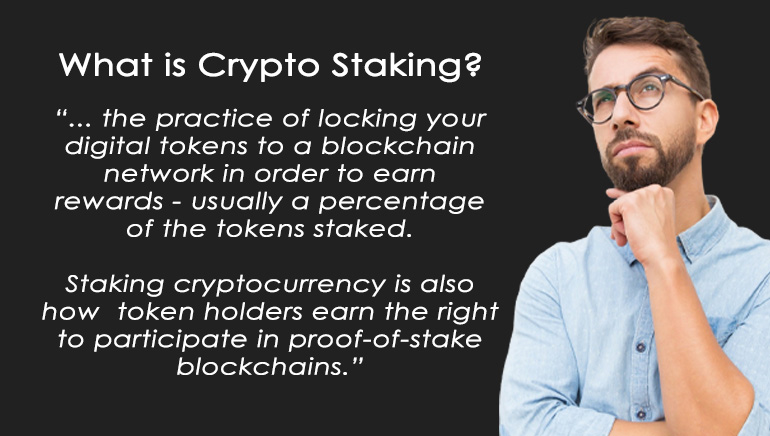
“... practice of locking your digital tokens to a blockchain network in order to earn rewards—usually a percentage of the tokens staked. Staking cryptocurrency is also how token holders earn the right to participate in proof-of-stake blockchains.”
In short, this is similar to how a poker room operates. It allows players to compete head-to-head at their table; they manage the deposits, withdrawals, and the flow of the game. At the end of the game, they take a cut of the pot as a service fee.
Crypto staking allows investors to assign a portion of their holdings to a staking platform, based on the advertised rate of return, for example, 5% for 30 days. The investor receives interest on their stake at the end of the period.
Punters who are holding large sums of crypto tend to have delegated gambling balances, and as this pot grows, they look for ways to keep it active without risking it all on crash games and live dealer bets.
Staking has become a fantastic way to ensure their portfolio remains active and gains value without being used for online gambling. The experience is akin to betting on low-volatility games; sure, the wins are not astronomical, but it's fun to see your balance ticking up over time.
Also, there is a particular pleasure in being the house for a change, rather than the one competing against it. Staking is essential for the viability of crypto platforms as it ensures that networks add accurate new information, and it is used to defend against network control attacks (also known as 51% attacks).
All of this and you earn passive income for investing your tokens into the network for short periods, making it the ideal intersection of risk versus reward for online gamblers.
With the mention of risk versus reward, we have to clarify that, much like any sports bet or casino wager, cryptocurrency staking is not a guaranteed win.
Anytime you place an asset under the control of a 3rd party, there are risks - here are some of the things to consider before staking:
Even with all precautions, slashing penalties can still occur, and they may cost you part or even all of your staked tokens..
This is because, in a Proof-of-Stake (PoS) network, validator activity is monitored by a smart contract that defines the rules of participation. If those rules are broken, whether intentionally or not, the contract can automatically trigger penalties, including the loss of staked tokens.
If a validator using your funds is deemed to be validating conflicting blocks (called double signing), or goes offline too often, resulting in missing blocks, they may be penalised by having a portion of their staked crypto permanently taken away or being removed as a validator.
In both instances, there will be a negative impact on your expected returns, or even lose a portion of the coins you set as the stake.

If you prefer to trust the growth of your crypto holdings to your luck at the tables, rather than the whims of a network validator, we recommend checking out these highly recommended crypto casinos.
Each operator offers a generous welcome bonus that guarantees a tasty boost to your bottom line from the outset, and you get to actively enjoy some of the best mobile slots, arcade games, and live dealer gameshows the internet has to offer.
 Approved


 Approved
 Hot
Hot


 Blackjack
 Slots
Slots Roulette
 Baccarat
 Craps
Craps Poker
Poker