We investigate why Alibaba is spending $450 million on boba tea to promote its AI platform and what this could mean for the future of online retail and chatbot recommendations.
When the world thinks of artificial intelligence (AI), it often comes up with off-the-cuff use cases: cheating on essays, turning photos into drawings, and using platforms like ChatGPT as an easy-speak version of Google.
However, in the business world, AI powers all kinds of daily-driver tools, from email management to chatbots, and more recently, payments.
Join us as we take a look at how AI tools are crossing over from simple search-style results to personalised recommendations and even actioning purchases - all in a way that is surprisingly intuitive and practical.
Whenever you're looking at tech and innovation, China will be one of the countries pushing the envelope, while maintaining a love and appreciation for longstanding traditions and cultural norms.
The tradition of giving hong bao, red envelopes filled with money, as gifts during key holidays and special occasions like weddings has persisted from the time of the Han Dynasty, which was founded around 202 BC.
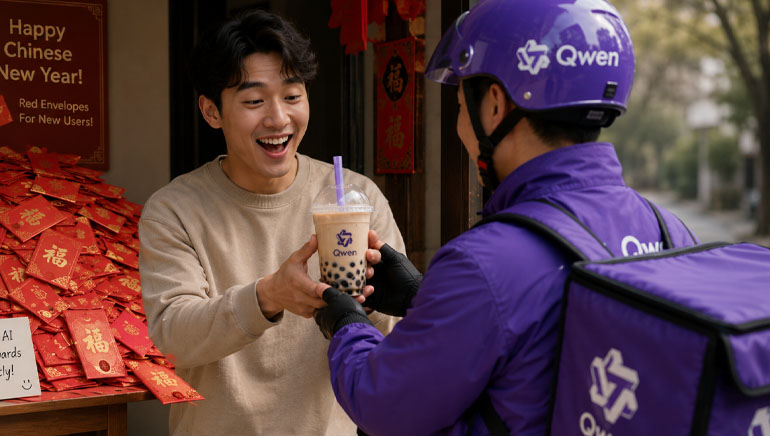
In modern China, technology companies began to encourage adoption of their payment and shopping platforms by giving away virtual red envelopes to new users as a welcome bonus when they signed up.
Recently, Alibaba, a market-leading e-commerce, retail, Internet, and technology company based in China, switched from the traditional hong bao incentive to something as deeply entrenched in local culture: boba tea.
If you’re unfamiliar with boba tea, it's a milky tea, often sweet, that is served with the lower portion of the cup filled with flavoured tapioca balls.
Originating in Taiwan back in the 1980s, this tea-based drink has become incredibly popular in China and even made its way to Western shores, where it became popular with fans of anime and other aspects of Asian culture.
As expected, the 2026 Chinese New Year kicked off with several tech companies offering users in China free money for joining using their AI tools and applications. Baidu committed $70 million in gifts, with TenCent announcing it was committing $140 million.
All users had to do was share a link to these companies' AI chatbots, and they would receive a no-money-down bonus. Naturally, this saw TenCent and Baidu take first and second spot in the Apple App Store with their respective mobile apps.
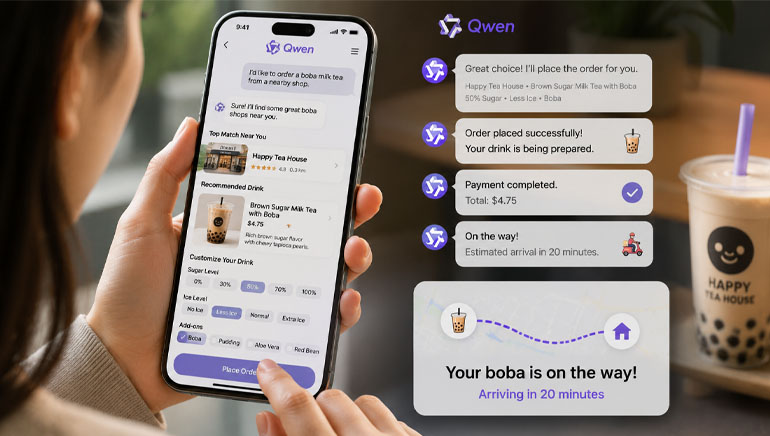
Alibaba’s decision shook the market; rather than offering red envelopes, they asked users to use their version of ChatGPT called Qwen to order and then purchase a boba for them from a local tea shop. In return, Alibaba would pay for the milky tea treat and its delivery.
The company's budget for this campaign is reported to be $450 million!
As human beings, we tend to adapt quickly to things that make our lives easier. This is sometimes described as hedonic adaptation, where improvements that initially feel remarkable eventually become the new normal.
A decade ago, getting detailed and helpful search engine results was seen as incredible. With the advent of ChatGPT and other large language model (LLM) tools, we want to have conversations and receive personalised responses.
This campaign by Alibaba is looking to once again evolve what is expected from technology. Once consumers become accustomed to having AI handle these everyday tasks, going back to doing them manually may feel unnecessarily difficult.
Unlike its competitors, Qwen does not simply offer Chinese users recommendations on which tea shop to consider shopping at.
As part of the Alibaba ecommerce ecosystem, Qwen does the following:
The most important part of this is that at no time does the user leave Qwen to visit a banking or food delivery app or website. The entire process takes place in Qwen!
This campaign is training users to expect quicker and more personalised responses to queries, and by plugging in AI tools to take action on our behalf and execute simple tasks, we will become more addicted to this level of service, no matter how invasive it ultimately becomes.
The result is a potentially powerful behavioural shift: the technology doesn't need to force us to use it. It simply needs to become the easiest way of getting things done.
In this case, Alibaba doesn’t have to own the tea shop to influence consumer and market behaviour. Analysts have reported that there has been a marked and ongoing increase in boba tea consumption in China in the wake of this campaign.
Reports vary as the campaign is ongoing, but figures show that the overall boba tea market in China has increased in value by between 5% and 10%.
The questions that arise from this type of interventionist AI are: what happens when the company that dominates the user base begins to determine consumer behaviours?
This could give Alibaba significant power over competing companies by directing consumer spending towards businesses it supports, or better yet, owns. Effectively chipping away at a free market economy and creating an environment where corporations begin to dictate, rather than simply influence, where users spend their money.
With Alibaba's network including restaurants, travel, retail, entertainment and financial services, this level of influence is toeing the line of becoming dangerous.
While less noticeable due to its application being in a closed environment, the online casino and sports betting sectors are beginning to offer similar services.
AI is being used to recommend games, promote sporting events, and offer personalised odds and marketing campaigns.
Safer gambling enquiries are looking into whether this level of personalisation is crossing the line from customer service into inducement, where punters are being encouraged to gamble on events and make real money deposits which fall outside of their usual gambling activities.
There is also a future where, like paid ads, AI recommendations become paid-for commodities with Claude, ChatGPT and other platforms recommending gaming sites and sportsbooks based on commercial agreements rather than their alignment with the users' stated needs or expected outcomes.
In an ideal world, regulators will onboard AI and user behaviour experts to monitor and address these concerns proactively. Rather than trying to rein in these types of influence-driven marketing campaigns once they’ve gained momentum.


 Blackjack
 Slots
Slots Roulette
 Baccarat
 Craps
Craps Poker
Poker